13.11.09

A Great LOUISE FISHMAN Painting
at Lennon Weinberg

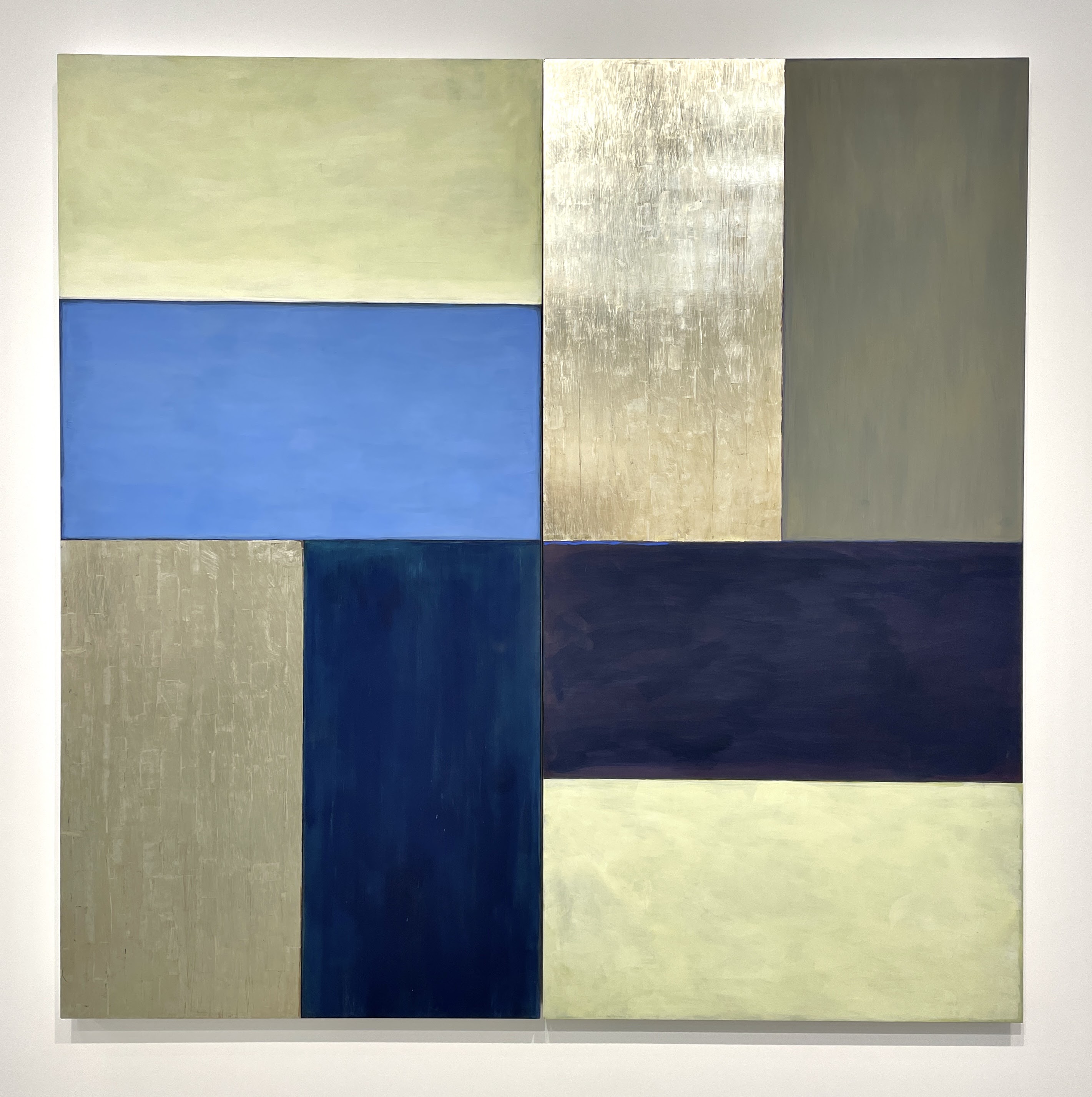
Louise Fishman, Magma, 1989, 65 x 54 inches, oil on linen

This stunning Louise Fishman painting is in an exhibition called Before Again at Lennon Weinberg in Chelsea through November 28. In addition to this and one other beauty by Fishman, the show features some marvelous paintings by Joan Mitchell, Harriet Korman, Melissa Meyer, Jill Moser, and Denyse Thomasos.

8.11.09

Studio Visit: KAZIMIRA RACHFAL

Kazimira Rachfal, studio wall w/ group of black paintings

It is always an exciting privilege to visit another artist's studio, to see work in progress, or finished work that has never been shown, and an environment that reflects working and thinking processes. I recently had the pleasure of visiting Kazimira Rachfal in the fantastic Soho studio she shares with her husband, painter Eric Holzman and their son. Eric was savvy enough to acquire this loft in the late '70s, just before the real estate boom priced these classic spaces out of reach of most artists. In addition to being extremely warm and generous people, Kazimira and Eric are dedicated hard working painters doing wonderful work.

Kazimira Rachfal's recent paintings are intimate in scale, and highly sensuous in their humble materiality. Working with an endless variety of simple geometric configurations, she goes about creating delicately layered surfaces and finely intuited relations among colors, shapes, edges and planes. Thin veils of oil paint are applied, scraped, dripped to form subtly colored accumulations with an equilibrium that is slightly askew, and always unified by the richness of the surface and the focus of a simple dynamic relation. In one area of her studio, Kazimira has collected various small bits of paper and fragments found on the street, each an example of the sort of integral happenstance that she notices in the world, and which she values as a source of release from convention. Indeed that release from convention is a key element in the resonance of Kazimira's work, in her dedicated mindful search for direct experience, and in the dialogue that occurs between the intensity of her intent and the apparent offhandedness of her process. She repeatedly achieves a plain-spoken visual poetry that is disarming in its simplicity, and in its beauty.


Kazimira Rachfal, oil on canvas, about 10 x 8 inches
(sorry I do not have titles for these paintings -- and all dimensions are approximate)

Kazimira Rachfal, oil on canvas, about 10 x 10 inches

Kazimira Rachfal, oil on canvas, about 14 x 11 inches

Kazimira Rachfal, studio wall

Kazimira Rachfal, oil on canvas, about 8 x 10 inches


Here is a view of Eric's studio space where he is finishing paintings for a show that will open November 21 at Sideshow in Brooklyn. More on that later.


Eric Holzman, studio view w/ new paintings & firetruck

Thank you Kazimira and Eric for a lovely visit.

7.11.09

HELMUT FEDERLE at Peter Blum

Helmut Federle, Scratching Away the Surface, Installation, 2009

Helmut Federle, Requium for My Cat, 2009, oil & acrylic on canvas, 60 x 50 cm

An exhibition of five new paintings by Helmut Federle, titled Scratching Away the Surface, is at Peter Blum in Soho through January 2, 2010. These small understated paintings are installed to powerful effect in Blum's cavernous shoebox shaped space, with many meters of white wall between each work, so the paintings at first read as tiny dark spots punctuating an expanse of white. This separation serves to isolate each painting as a distinct moment, pulling us up close and eliminating the others from view, while simultaneously activating the whole space like a choreographed arena. The five paintings are all variations on a geometric spiral image that originates with light near the center of the canvas, and layer by layer, becomes darker and denser moving out to the edges. The paint is carefully scumbled in many thin layers with the tooth of the canvas causing surface irregularities as it catches small hunks of paint. Within such a focused program, Federle achieves a remarkable variety of effects from one work to the next, from dry schematic precision to fluid atmospheric space. These are rather modest paintings that collaborate with each other and with the gallery space to make a rather grand statement -- a metaphysical passage, stark and searching, penetrating toward light.

6.11.09

DON CHRISTENSEN: New Work

Don Christensen, Silver Button, 2009, 76 x 50 inches, oil & acrylic on canvas

Check out Don Christensen's exquisite new work on his new website.

29.10.09

In the Studio

Palette

18.10.09

MARA HELD at Kurnatowski

Mara Held, Hiroshige I, 2008, 24 x 32 1/8 inches, egg tempera on linen

Mara Held, Cypress, 2009, 10 x 8 inches, egg tempera on muslin over panel

Mara Held, Cypress (Detail)

Perfectly describing her work as "an investigation into the timbre of the physical world", Mara Held is showing a group of beautiful and intense abstract paintings at Janet Kurnatowski Gallery in Brooklyn, through November 15. Using a meticulous and painstaking traditional egg tempera process, Held builds rich layered surfaces -- actually low reliefs -- that craze and fray at edges conveying a deep sense of time, and possessing a hand-made almost brittle delicacy, with the tooth of the linen support adding the suppleness of an old tapestry. Held's images are infused with lively color and undulating linear topographies that shimmer with opticality, like visualizations of ecstatic impulses. These paintings are deeply sensual objects that, in their facture and their dynamism, are able to convey surprising states of saturated sensation.

10.10.09

In the Studio

True Love Never Die, 2009, 72 x 54 inches, acrylic on canvas

MORE PAINTINGS HERE

6.10.09

In the Studio

Mother Tongue #8, 2009, 24 x 18 inches, acrylic on canvas

MORE PAINTINGS HERE

5.10.09

COLOR-TIME-SPACE
at Lohin Geduld & Janet Kurnatowski

Kim Uchiyama,Untitled, 2009, 19 x 14 inches, oil on canvas

Joanne Freeman, Bent, 2009, 20 x 25 inches, oil & wax on canvas

Acknowledged affinities between painting and music must surely be prehistoric in origin -- being, along with movement/dance, among the most elemental of human impulses. Of course abstract painting has always been talked about in musical terms, specifically aligned with music as a parallel language. This analogy has mostly been perpetuated not by critics but by artists themselves because indeed the process of manipulating the formal dynamics of the two ineffable substances, color and sound, is virtually the same.

The postulation of abstract painting as a "musical" idiom is the theme of two simultaneous shows under one title, Color-Time-Space, at Lohin Geduld in Chelsea and Janet Kurnatowski in Brooklyn through October 10. Curated by painters Joanne Freeman and Kim Uchiyama, and drawn primarily, but not entirely, from the stables of the two galleries, this is a lively and yes, musical show of small abstract, mostly geometric, paintings. Featuring the work of 13 painters, each offering a distinct illumination of the theme, the show is more than anything a resounding affirmation of the vitality of abstract painting. Some of the many outstanding works include a reprise of new Thornton Willis paintings that we saw at Elizabeth Harris last season, the funky configurations and lustrous surfaces of Laurie Fendrich, Julie Gross' exquisite color and rhythmic circle motifs, and juicy open-ended gestural works by James Biederman. For me, the big surprise was the work of Kazimira Rachfal.

Kazimira Rachfal, in a certain sense (iva), 2009, 18 x 10 inches, oil on canvas

Kazimira Rachfal, so to speak (iva), 2009, 17 x 7 3/4 inches, oil on canvas

A bit more stark than the other work in the show, her small abstractions are finely tuned poetic configurations in which the perfectly proportioned shapes, the layered oil surface, and the verticle format engage to form a sort of perpetual, slightly shifting tension -- like a long, deeply resonant, modulated hum.

2.10.09

MARK BRADFORD & KARA WALKER
At Sikkema Jenkins

Mark Bradford, Red Painting, 2009, 101.75 x 143.5 inches, mixed media collage on canvas

Mark Bradford, The Middle Path, 2009, 48 x 60 inches, mixed media collage on canvas

Kara Walker, 10 Years Massacre (and its Retelling) #2, 2009, 84 x 72 inches, mixed media, cut paper & acrylic on gessoed panel

Showing together at Sikkema Jenkins through October 17, Mark Bradford and Kara Walker present distinct but overlapping bodies of work that resonate with the confidence of two accomplished artists in full stride. It is a rambling exhibition that features large and small scale paintings, text-based collages and a sculpture by Bradford, and large scale paintings, small collages and two new videos by Walker.

Mark Bradford is known for building huge paintings, or more accurately, collages out of cultural detritus -- layers and layers of paper from billboard ads and street fliers. He uses heavy twine to form complex webs that resemble topographical layouts for neighborhoods. These layers are painted over, torn away, sanded through to arrive at surfaces that have a deep history of their own which mirrors that of their original source -- the inner-city landscape. In this show, we see only one of the really big pieces, the magnificent Red Painting which is more than 12 feet long and dominates the first room of the gallery. In the side gallery, Bradford has made a group of 4 by 5 foot elaborations on canvas -- same palette, same basic triangular grid configuration as Red Painting. In addition he is showing a group of very small collages on paper that feature advertising slogans. The small canvases are indeed extremely beautiful objects, but at first, because of their smaller scale they begin to look precious, a bit too controlled, and so very tasteful. What's missing is the obsessiveness, the edge, the sheer magnitude and scope of the big pieces. On second viewing however, I began to see and appreciate them in their own right as highly charged, and quite elegant chunks of physicality -- like focused details of the large pieces, and definitely holding their own. In his only 3-D piece in the show, called Stax, Bradford builds a 12 foot high pile of papier mache volleyballs, contained by a triangular-grid mesh that echoes the paintings. It is monumental and funky in its presence, and a welcome shot of the artist's sense of humor.

Kara Walker shows a large group of small collages and cut paper pieces that feature the same silhouette figures, scenes and situations that have characterized her work. What is new (at least to me) are three large paintings (also technically collages) titled 10 Years Massacre (and its Retelling), in which Walker departs from her usual narrative tableau space, and incorporates her imagery into a fragmented painting space with rich black surfaces. These are knockout paintings -- powerful visual statements that do not rely primarily on narrative for their power, and have gutsy, visceral weight that we haven't seen in Walker's work. This visceral quality is followed through in the back room of the gallery with two new videos -- gritty, handmade affairs featuring her silhouette puppet figures re-enacting scenes of unspeakable brutality and violence from America's racist history. In their directness and simplicity, these are gripping works that powerfully convey the depth of human tragedy in the events and attitudes they portray.

23.9.09

SLIPPERY WHEN WET at Metaphor

Joanne Mattera, Silk Road Series, encaustic on 18 panels, 12 x 12 inches each


Andrew Mockler, Untitled Blue 1, 72 x 29 inches, oil on canvas


Don Muchow, Water Study #3, 20 x 30 inches, archival ink jet print


Nancy Manter, Pane #2, 48 x 38 inches, C-print


Metaphor Contemporary Art in Brooklyn opens the season with "Slippery When Wet" (through November 22), a group show that extends that summer feeling of a breezy day at the beach with a focus on the theme of water. Presenting the work of seven artists: Suzan Batu, Susan Homer, Nancy Manter, Joanne Mattera, Andrew Mockler, Don Muchow, Peter Schroth -- this beautifully curated show offers a nice range of approaches to photography, descriptive painting, and pure abstraction, all dealing loosely or directly with some aspect of the aquatic realm. There are many wonderful relations and conversations among the works -- the image or sensation of pooling tidal ebb and flow brings the abstract calligraphy of Batu and the traditional oil waterscapes of Schroth together with Muchow's glistening zenlike photographs, and is also echoed in Mockler's shifting horizontal stripes and Mattera's modulating color. The fluidity of calligraphic markmaking dominates the work of Batu and Schroth, as well as Homer's large etherial landscape, and is expanded in Manter's photos of panes of glass which read like gestural abstract paintings. The entire show is infused with soft blues, silvery grays and silky surfaces. The centerpiece of the show is Mattera's selection of 18 encaustic panels that occupy the end wall of the gallery, and exquisitly embody the show's theme in an endless and expansive exchange of color resonance and shimmering surface that embraces the viewer like an ocean breeze on an August afternoon.

To see a pictorial walk-through of the exhibition as well as candid shots of the opening, go to Joanne Mattera's Blog.

22.9.09

MAYA LIN at PaceWildenstein

Maya Lin, 2x4 Landscape, 2006, 10' x 53'4" x 35', wood

In her first exhibition at PaceWildenstein in their 22nd Street space (through October 24), Maya Lin continues to give us expansive works of elegance and eloquence. The show consists of three pieces, each made of one material -- aluminum wire, plywood, 2x4s -- and constructed with disarming directness. All three works are manifestations of Lin's experience of landscape, both analytical and intuitive. By far the most impressive piece is "2x4 Landscape", in which she has placed more than 50,000 2x4s of varying lengths on end to form an undulating indoor landscape that rises to a 10' high hill. The piece is perfectly situated in the space with a pathway around the perimeter, and has a physical presence that is both astounding and delightful. This is pure sculpture -- the artist engaged in a deep dialogue with the physical world, enlarging and elaborating her experience with visual poetry of the highest refinement.

11.9.09

GONÇALO IVO: New Work

Gonçalo Ivo, 2009, 97 x 195 cm, oil on canvas

Gonçalo Ivo, 2009, 114 x 195 cm, oil on canvas

Gonçalo Ivo: Paintings and Objects, featuring work by the wonderful Brazilian painter who spends half his time in Paris, is underway at Multiarte Gallery in Fortaleza, Brazil, through September 19. The beautiful exhibition catalogue includes my essay, "The Paintings of Gonçalo Ivo" in Portuguese and English -- read it here in English.

5.9.09

REBECCA PURDUM at Dartmouth

Rebecca Purdum, Static, 2005, 108 x 72 inches, oil on canvas


Rebecca Purdum, Passenger, 2003, 72 x 144 inches, oil on 2 canvases


Rebecca Purdum, Ripton 77, 2008, 16 x 16 nches, oil on board

My first encounter with the work of Rebecca Purdum was her first show at Jack Tilton in 1986 -- when Tilton had just recently taken over the charged 57th Street space after the death of Betty Parsons. Thinking now about that show, it is easy to conjure the sensation of entering, in that mid-'80s climate, the first show of a very young painter who was already deeply tapped into an elemental engagement with the painting process and tradition -- who was not playing strategy games or asserting a stance, but making the most direct and substantial paintings I had seen in a long time. She painted lush darkly colorful abstract works with her hands on a huge scale -- paintings that were powerfully moving and instantly venerable. A few years later, in what seemed like utter disregard for her "career", she relocated to Vermont, where she still resides. During the past almost 25 years she has shown rarely and exclusively with Jack Tilton (not a bad gig) while forging her way deeper and deeper into an encompassing symbiosis with her process, and with painting as an entity. Remarkably, the longer she lives in the country, the tougher her paintings get. The sensate clouds of swirling color that characterized those earliest pieces have evolved into stark undulating fields of raw sensation -- pure paint and surface -- ecstatic touch.

The Hopkins Center, Dartmouth College will be presenting, from September 29 - October 25, what looks to be a Rebecca Purdum mini-retrospective that highlights some of the toughest early works and is heavy on large recent work. From the catalogue I just received, this looks like a knock-out show of haunting enigmatic paintings that confirm Rebecca as a singular and important (still young) painter who has sustained a rare depth and focus over a quarter century.

In 1997, I was honored to curate a show of Rebecca's paintings at Marywood University. Click here to read the catalogue essay. And click here to read a wonderful lecture/statement by Rebecca from Middlebury College, 2007.

20.8.09

In the Studio

Mantra #2, 2009, 84 x 60 inches, acrylic on canvas

MORE PAINTINGS HERE

12.8.09

MARGARET NEILL - Drawings
At Pelavin Projects

Margaret Neill, Traces #7, 2009, 22" x 30" page, 18" x 25.5" image, charcoal on paper

Margaret Neill has completed a beautiful new series of charcoal drawings, being presented as an online project by Cheryl Pelavin Fine Arts in Tribeca. These are deeply sensuous works with dense black shapes built from layers of charcoal rubbed into the surface of the paper, and white spaces activated by charcoal smudges and erasures. The images are simple curves and intersecting geometries, fragments of infinite configurations that form focused interactions of light and dark -- an elegant fusion of physicality and grace.

8.8.09

Summer - Light & Color

Dan Flavin, Untitled (to Ksenija), 1985, fluorescent light, 96" high

Tucked away in the back room at Andrea Rosen, in the company of an unremarkable group of minor works by Andre, LeWitt, Mangold and Ryman, is this Flavin piece. It's sometimes easy to dismiss these works now as iconic relics -- but in the context of the utterly dry work by his compadres, and the lackluster summer shows in general, this pure piece of oozing light and color takes on a particularly welcome enveloping sensuality. You can call this Minimalism if you want, but its effect is maximal, and as vital now as ever.

I hate to even mention it, but in stark contrast, the main gallery features a big show of drawings by John Currin that, with only a few exceptions, looks like the work of a very facile adolescent boy who has only been exposed to Playboy and Norman Rockwell.

1.8.09

FEMALE GAZE: WOMEN LOOK AT WOMEN
At Cheim & Read

I usually really enjoy the summer group shows as a nice way to see work from some artists I've missed during the season, and get a sense of the big picture. This time, on my admittedly quick and incomplete runthrough of Chelsea, I was struck by a pervasive sense of depression -- a sort of hunkering down waiting for the present to be the past -- very low energy to the point of apathy. One of the few high points I encountered was at Cheim & Read, where an intriguing exhibition titled Female Gaze: Women Look at Women presents a wonderfully diverse group of work by women with women as the subject.

Hannah van Bart, Dawn, 2007, 69" x 57 1/8", acrylic on linen

Nan Goldin, Amanda at the Sauna, Hotel Savoy 1994, 30" x 40", Cibachrome print

Shirin Neshat, Pari, 2008, 72" x 49 1/2", Cprint & ink

The premise of the exhibition is a re-imaging of femaleness, and the assumption that there is a different dynamic that takes place between the artist and subject when both are women. While this premise may be a little nebulous, and not necessarily evident in some of the work, it has nevertheless served as a great catalyst for the gathering of powerful works in a variety of media by some great artists. There is the famous and rarely seen early Lynda Benglis video piece called Female Sensibility, a solid Alice Neel portrait, and a surprising Cezannesque early Joan Mitchell academic nude. Other outstanding pieces include a wild Marilyn Minter, a Ghada Amer thread piece, and a sensuous Julia Margaret Cameron portrait. As for the premise -- whether by a man or a woman, these images are still objectified, eroticized, and subjected to the viewer's gaze. There is however a different kind of eroticism here. The subjects almost always look straight back at the viewer, asserting a self possessed presence and control. There is still a distinct vulnerablity within the dignity of these women, it's just that their vulnerablity is not in their femaleness, but in their humanness.

For a beautifully comprehensive tour of the Female Gaze exhibition, go to Joanne Mattera's blog.

This exhibition is an interesting elaboration on last month's show at Cheim & Read, recent paintings by Chantal Jaffe. While owing a deep debt to Alice Neel, Jaffe possesses a freewheeling facility and a frankness that distinguishes her among figure painters. Her compositions are often surprising, and her images are built out of slabs of juicy oil paint. Sometimes self-portraits, and sometimes portraits of friends, her images possess a blank disinterest while staring right at us.

Chantal Jaffe, Green Dress Black Knickers, 2009, 84" x 55", oil on board

Chantal Jaffe, Purple Blouse, 2007, 120" x 60", oil on board

All images Cheim & Read

25.7.09

In the Studio

Mother Tongue 3, 2009, 36 x 20 inches, acrylic on canvas

MORE PAINTINGS HERE

18.7.09

MOTHERWELL - OPEN in London

Robert Motherwell, Untitled (Ultramarine & Ochre Open), 1973, 69 x 44 inches, acrylic on canvas, Bernard Jacobson Gallery

I can't deny that Motherwell was a major figure in my early artschool days. Seeing one of his Elegies for the first time in 1971 at the Dallas Museum of Art was an important formative moment. Over time, those mid-career Motherwells haven't held up particularly well compared to the classic work of many of his contemporaries. But the Open Series was his late breakthrough -- unquestionably his most enduring contribution -- when he occasionally escaped his own mannerisms (if not Matisse's) to make tough and simple declarative paintings. Through August 28, the Bernard Jacobson Gallery in London is featuring a group of these works in conjunction with the publication of a book on the Open Series from 21 Publishing.

11.7.09

PAMELA FARRELL's New Photos


Pamela Farrell, Recent Digital Photographs

New Jersey based encaustic painter Pam Farrell has recently created a new blog for posting a remarkable group of new photographs. These digital images are wonderful translations of her painterly sensibility to the mode of captured image. They could operate as studies for the paintings, but they absolutely stand on their own as photographs and as abstractions from nature.

And ----- her new paintings are really humming.

Pamela Farrell, False Walls (Umber), 2009, encaustic on panel, 24 x 24 inches

TERRI BROOKS

Terri Brooks, Edges, oil on canvas, 41 x 31 cm

Terri Brooks, Zero, oil & enamel on canvas, 41 x 31 cm

Terri Brooks, Beige with White Spots, oil & enamel on canvas, 122 x 84 cm

Melbourne, Australia painter Terri Brooks works with layer after layer of marks and scrapes to create offhanded configurations and sumptuous surfaces that are instilled with deep physicality and cultural resonance. Her paintings are sensual melting pots, inclusive embodiments of archetypal impulses.

6.7.09

In the Studio

Shine Eye, 2009, 48 x 36 inches, acrylic on canvas

MORE PAINTINGS HERE

5.7.09

The Baptistery & San Miniato, Florence

This is the last of the posts from my residency in Florence. The Baptistry is sometimes the first and always the last place I go when I'm in Florence. The oldest building in the city, it is thought to have originally been a pagan temple, converted to Christian use in the 5th century. The building we see now was reconstructed in about 1050, then embellished over the next four centuries. The interior is an amazing amalgam of symbols and influences -- East/West, Pagan/Christian, Antiquity/Byzantium/Renaissance. The domed ceiling and other parts of the interior are covered with impressive 12th century gold-leaf mosaics in the Byzantine style. But I'm much more interested in the earlier stuff - the intarsia patterns and symbols based on natural forms and obviously derived from Pagan iconography that occupy the walls, upper niches, and the floor.


The exterior of the Baptistry is also amazing. It is of course famous for the Ghiberti bronze doors on the north side -- all polished and shiny, they are constantly surrounded by a herd of tourists. But around each corner of the octagonal building is a remarkable set of niches and relations created by the distinctive green & white marble.


High on a hill overlooking Florence is another magnificent place, San Miniato Al Monte, completed in 1207 and formally influenced by the Baptistry. Here we see a large-scale improvisation on many of the elements that make the Baptistry such a special place.


4.7.09

Aesthetics of Decay - Part 2:
Cimabue & Giotto at Assisi
& Uccello's Green Cloister

For painters, the Basilica of St. Francis at Assisi is one of the most magnificent places in the world. Being there, it's easy to imagine this place as a hot-house of creative activity and experimentation in the late 13th & early 14th century, when the greatest painters in the world at that time, Cimabue and his student Giotto and all their crew, were throwing down on every surface on both levels of this cavernous cathedral.

Seven hundred years later, the color here is like no other place -- deeply rich, warm and sensuous, with a gentle gray/green patina on every surface -- it absolutely envelops your senses. What we see here is possibly just as overwhelming as it must have been when it was made. But the fact is, what we see now is not at all what was originally made, but rather a hybrid, a collaboration between the painters and the natural elements over time. There is no way to know what these paintings looked like originally -- what we do know is how they look now, which is unimaginably beautiful.

Cimabue, Crucifixion, 1280, Basilica of St. Francis, Assisi

Giotto, St. Francis Exorcising Demons, 1296-1304, Upper Church, Basilica of St. Francis, Assisi

Giotto, Sermon to the Birds, 1296-1304, Upper Church, Basilica of St. Francis, Assisi

In Florence, in the cloister of Santa Maria Novella is a remarkable early cycle of paintings by Uccello that are so weathered by time and moisture that some are almost gone. Here are a few of the less decayed fragments. Much like the Cimabues at Assisi, the color and value contrasts are transformed to a radical new state.

Paolo Uccello, Scenes from the Flood, 1432, Cloister, Santa Maria Novella, Florence

Paolo Uccello, Scenes from the Flood, 1432, Cloister, Santa Maria Novella, Florence

3.7.09

Ligurian Sea


2.7.09

Mercato Centrale - Florence

Laura getting a taste from her favorite cheese guy

A vegetarian's paradise


For any hard core foodie, Italy is the place. Yea there's great art, great architecture...but the food! One of the real privileges of an extended residency in Florence is having a kitchen and being able to prepare meals with all the best ingredients in the world, and shopping at the Mercato Centrale, a massive two-story warehouse the size of a city block full of vendors --- fresh produce upstairs, cheeses, meats, homemade pastas downstairs. Why don't we have places like this in the states?

And we won't even mention the coffee.

29.6.09

Aesthetics of Decay - Part 1:
Walls of Italy

The surfaces of Italy are seductive beyond imagination -- an ultimate collaboration between human construction and natural elements, seasoned and intensified by time. Although usually the product of futile attempts to stave off decay, the layers of history inevitably merge and continue to accumulate. It's easy for a painter to think they do this just for us!


Note: no color enhancement was used in these images.

27.6.09

Back from FLORENCE

A small portion of an exterior wall of the Baptistery, Florence, Italy

I've just returned from my too-short residency in Florence with lots of stuff to show and tell. To begin, just a little taste of the magnificent visual richness that permeates this great city. Having spent quite a bit of time in Florence over the past ten years, I feel very much at home in this place. I will be posting images and observations from Italy in the coming days.

25.6.09

Lisa Pressman's Blog

Thanks to painter Lisa Pressman for including me in her blog series on artists' influences. I could add many more names to the list.

I return from Italy tomorrow....sadly. But having been here without a computer, I've got lots of stuff to post when I get home.

10.6.09

SOPHIE MUNNS - New Blog

Sophie Munns, Beach Reverie, 2008, 1.2mt x 900ml, acrylic & collaged canvas

There's a great new blog on the block by Australian artist Sophie Munns. It is packed full of wonderful diverse images, and focuses on the richness of visual experience in all its aspects.

9.6.09

THORNTON DIAL & BILL ARNETT
On the Kalm Report

Thornton Dial, Out of Control, 2003. 75" X 123 1/2" X 6",
tin, wood, string, soil, oil, enamel, spray paint, and Splash Zone compound on canvas on wood

Mr. James Kalm ventures way off his beaten path (and his bike) to Atlanta for a visit to the Bill Arnett Collection, which includes hundreds of amazing pieces by Thornton Dial. James' video gives us not only a great look at this phenomenal sprawling collection, but also features a remarkable interview with Arnett, a scholar of African American culture. His encapsulation of the cultural and aesthetic importance of this work is excellent. Check it out.

4.6.09

HELEN MIRANDA WILSON in Boston

Helen Miranda Wilson, Sonya Alexandrova, 2008, 7 5/8" x 8 3/4", gouache on paper

Helen Miranda Wilson, Eye Cup Halo, 2008, 8 3/4" x 8 7/8", gouache on paper

I picked this up from Two Coats of Paint -- thanks Sharon. Helen Miranda Wilson is showing a group of new works on paper at Victoria Munroe in Boston through June 20. I assume she approaches these new gouaches in the same way as her earlier horizontal stripe paintings, building the image intuitively one color at a time, probably starting in the center. These new pieces are real beauties -- focused color meditations, human and universal. More images on the gallery website.

31.5.09

DON VOISINE at McKenzie

Don Voisine, Inauguration, 2009, 60" x 60", oil on wood


Don Voisine, Connection, 2007, 17" x 26", oil on wood


Don Voisine, Sidekick, 2008, 36" x 18", oil on wood

The primary principle at work in the paintings of Don Voisine, thru June 6 at McKenzie Fine Art, is compression -- like the stuff that oozes out between your fingers if you squeeze a handful of mud, the action in Voisine's paintings happens at the pressure points between opposing forces. The compositions themselves are embodiments of this pressurized tension, colorful and speedy around the edges, becoming slower and more dense at their black center. Voisine is able to wring an amazing amount of variation from very few well-chosen elements. Most engaging is the variety of blacks -- purples, greens, blues, reds -- all masquerading as black, with wonderful contrasts between matte and glossy surfaces that change as you walk around the piece. These blacks are activated by strips of pastel or sometimes almost day-glo color of varying widths aligning the verticle or horizontal edges. The X formed by the two intersecting black slabs on a white ground causes a dance of triangular shapes between the black and the bright color. Voisine has found a universe in Malevich's tilted square.

26.5.09

Ranking Reverb #1:
MARTIN, MARDEN, PALERMO, TRUITT

When I was a kid, my brother and I used to speculate endlessly about what combination of great musicians would comprise the ultimate dream band. In that spirit, and just for fun, Ranking Reverb is conceived as an occasional series of online exhibitions -- dream shows if you will. So here is the first -- a group of Ranking artists who pioneered primary structures while exploring the nuances of materiality and color.

To quote Louise Fishman, "Agnes Martin is the Buddha". Her paintings are the visual equivalent of breath -- the weave of the canvas, dry pencil line, light wash of translucent color -- silent, still, inclusive -- nothing and everything. They convey an expansive stasis, an ineffable wholeness in the humble and patient frankness of her process.

Brice Marden's early monochromes and color panel paintings were at once conceptually rigorous and deeply sensual. His heavily worked oil and beeswax surfaces were inhabited by rich hybrid or fugitive colors arrived at through a process that was steeped in tradition and buzzing with intelligent intuition. As his configurations became more complex, his color became more adventurous, and impeccably refined -- and always surprising.

In the late 60s, Blinky Palermo arrived at an exquisite integration of color and material with his fabric paintings -- not really paintings, but colored fabric mounted on stretchers. He would continue to develop these concerns, exploring the inherent properties of various materials, shapes and colors, evolving into his last and most important work, To the People of New York City, which was shown at Heiner Friedrich in NY just after the artist's death in 1977. It was a concise group of paintings on aluminum panels with simple paired combinations of red, yellow and black, now permanently installed at Dia Beacon. In it's original setting at the Friedrich Gallery, the installation was a highly charged arrangement of stark and beautiful relations that revealed the mysterious associative power of color and material in an entirely new way.

Anne Truitt was a singular, and often overlooked figure in the world of sculpture, making works that I consider to be 3-dimensional paintings. Though certainly sculptural in their declarative presence, her elemental configurations employ a beautiful integration of color and shape as a source of archetypal resonance.

Ranking Reverb #1

Agnes Martin, The Sea, 2003, 60" x 60", acrylic & graphite on canvas


Agnes Martin, Gratitude, 2001, 60" x 60", acrylic & graphite on canvas


Agnes Martin, Untitled #21, 1988, 60" x 60", acrylic & graphite on canvas


Brice Marden, The Dylan Painting, 1966, 60" x 120", oil & beeswax on canvas


Brice Marden, Grove Group IV, 1976, 72" x 108", Two panels, oil & beeswax on canvas


Brice Marden, Elements V, 1982, 84" x 51", Four panels, oil on canvas


Brice Marden, Thira, 1979-80, 96" x 180", 18 panels, oil & beeswax on canvas


Blinky Palermo, Stoffbild, 1969, 200cm x 200cm, cotton fabric over stretcher


Blinky Palermo, Stoffbild, 1969, 200cm x 200cm, cotton fabric over stretcher


Blinky Palermo, Stoffbild, 1969, 200cm x 200cm, cotton fabric over stretcher


Anne Truitt, Catawba, 1962, 42" x 60" x 11", acrylic on wood
Anne Truitt, Watauga, 1962, 46" x 56" x 7", acrylic on wood


Anne Truitt, Twining Court, 2001, 70 1/4" x 8" x 8", acrylic on wood


"We hope you have enjoyed the show!"

17.5.09

Rothko Chapel

Rothko Chapel, Southeast, South and Southwest Panels

I have just returned from another brief visit to Houston to do some business at Gremillion & Co., and spend some time with Ron Gremillion and all my friends and colleagues at the gallery. On my first day there, I had a little down time, and decided to make another visit to the Rothko Chapel -- since I've been thinking about those late Rothkos lately, and every time I see the chapel works, they offer some new perception or moment. It was a glorious day with bright clear sunlight and some floating clouds. As always, entering the chapel was a drastic reality shift from the brightness and heat of the outdoors. The place was empty except for a greeter at the front desk and an extremely conspicuous guard sitting in a chair inside the chapel. In addition to the rough hewn benches, the floor of the chapel was strewn with small mats with little round pillows in the middle -- obviously to accommodate lotus sitters, but very distracting interruptions of the space. Their presence made me think about the dichotomy between the paintings, and the space as a "chapel" in which the paintings exist as part of a devotional or meditative environment. Of course the idea of the chapel came first, and the paintings were conceived specifically for that context, both in terms of physicality and content -- just as Rothko was chosen for the project presumably because of the compatibility between his work and the idea of the chapel. But to my mind, the paintings have outlived the original context -- like the Giottos in the Arena Chapel or the Caravaggios in San Luigi -- their sustained importance as paintings has rendered their ecumenical role quaint if not obsolete. The notion of attaching religiosity to Rothko's paintings is a warm and fuzzy product of a past era, and is in reality diametrically opposed to the utter anarchy of the works themselves. These paintings declare a reality of vastness and flux in which any notion of certainty, any doctrine or dogma is patently absurd.

On this day, the light in the chapel was particularly changeable. I sat on a bench for a while watching as the paintings transformed from huge active painterly surfaces revealed by the full (filtered) sunlight, to monolithic almost black slab/spaces devoid of surface as a cloud passed overhead. A few people came in, some alone and some in pairs, and I noticed that they hardly looked at the paintings -- rather, they sat and read the little brochure, or just sort of glanced around for a few minutes then left. The quiet stillness of the chapel can indeed be conducive to an undifferentiated state -- only because the paintings perform a strange trick of temporarily receding from physicality, of becoming absorbed into an experience of the space as a whole, reinforcing their ambiguity. Then just as suddenly, they reassert their fierce presence. For me, the less successful of the works are the two triptychs on the east and west walls with the elevated center panels -- they now seem almost mannered, and pandering to the ideological precepts of the chapel. The verticle painting with the floating black rectangle on the south wall advances Rothko's trademark image to a powerful stark intensity. But to my mind, the paintings on the four corner walls, along with the giant tour de force triptych on the north wall, are Rothko's greatest work. The sheer scale of these paintings is unfathomable -- all monochromes with different variations of layered washed surfaces and deep dull purples. Here Rothko repudiates any preconceptions about painting's parameters, and uses the chapel context as a catalyst to achieve an extravagant radicality. These are without doubt the most portentous paintings of the NY School generation; and their bold singularity, in sharp contrast to the ideological limits of their devotional setting, places them among the most important paintings of any era.

9.5.09

LANCE RUTLEDGE

Lance Rutledge, Untitled, 2006, 30 x 30 inches, oil on canvas

Lance Rutledge, Untitled, 2008, 40 x 50 inches, oil on canvas

I don't know much about Lance Rutledge, but there is a recent interview with him by Jon Lutz at The Old Gold. He is also showing tonight, May 9, at Studio 11 in L.I.C. in a group show called Central & Remote that also includes Carrie Pollack and many others. His paintings feature a finely tuned awareness of the poetic potency of words and images, as well as a great sense of humor. I particularly enjoy the slippages that occur in the verbal phrases, and how the seemingly unrelated words and images are mashed together to create surprising off-balance meaning. He has mastered a Twombly-esque artlessness that is supremely artful, making these paintings operate as both hermetic narratives and sensuous objects.

1.5.09

MARK WETHLI at Red Flagg

Mark Wethli, Westfield, 2009, 40 x 30 inches, acrylic on wood panel

I just encountered the work of Mark Wethli on Kate Beck's blog (thanks Kate). He is showing a group of mostly small paintings on found wood panels. The configurations are beautifully direct improvisational responses to the format, the surfaces are activated by the scars of their previous utilitarian existence, and the colors reference the folk art tradition -- an interesting hybrid. At Red Flagg Gallery in Chelsea through May 16.

26.4.09

BLANK CITY Premiers
at the Tribeca Film Festival

Patty Astor in a Still from Celine Danhier's BLANK CITY, 2009

Last night, Laura and I were privileged to attend the world premier of Celine Danhier's BLANK CITY at the Tribeca Film Festival. The film is a beautifully directed documentary montage about the underground cinema scene in New York in the late '70s and early '80s. The soundtrack features a great selection of music from that era by Patti Smith, Richard Hell, Contortions, DNA, Theoretical Girls, my old band The Dance, and many others. The narrative is carried by a series of fantastic interviews with many of the key players in No Wave cinema and music, including Amos Poe, Jim Jarmusch, Lydia Lunch, Beth & Scott B, James Chance -- and an incredible collection of film clips from long lost archives -- films so obscure that they may have only been shown once in somebody's apartment, but were nevertheless at the forefront of the fiercely iconoclastic creative groundswell of that moment in New York. Danhier's film gloriously and accurately portrays the scene's gritty, dangerous, druggy adrenalin, and while convincingly asserting the truth, courage, and historical importance of all those uncompromising projects, also erases any trace of nostalgia for that time.

23.4.09

TIM McFARLANE at Bridgette Mayer

Tim McFarlane, A Promise Kept, 2009, 16 x 20 inches, acrylic on panel

Tim McFarlane, This Moment (Detail), site specific, mixed media on wall

In its last week is a show of recent paintings by Tim McFarlane at the Bridgette Mayer Gallery in Philadelphia - closing on April 25. Consisting of a group of small panel paintings and a few larger works on paper, the show is perfectly scaled for the gallery space, and presents a great variety of Tim's trademark knitted gestural fields in dynamic and colorful compositions. In most of the paintings, the knitted field takes on the presence of a discrete organic shape which is held in a kind of suspended animation by the edges of the panel. Sometimes two or more fields overlap or form layers of repetitive weaving marks, with drips and wet-into-wet viscosity asserting the physicality of the surfaces. The most recent pieces tend to be the most stark and direct, often using the unpainted wood grain of the panel as the ground. In these works, Tim seems to be relinquishing some of the lushness of previous work in favor of a more straight ahead focus on process -- more interest in the larger relation between the knitted field and the ground rather than in effects of color nuances. Going a step further, the most recent thing in the show is an ongoing site-specific piece which the artist worked on throughout the duration of the exhibition. In a small but unique closet space, about 6 ft square with about a 10 ft vaulted ceiling, he has engaged in a daily process of revision and elaboration that has transformed the little space into a site of intense obsessive intervention. Beginning with slate black walls and ceiling, every inch of surface in this room has been inscribed with marks using chalk, dry pigments, and white paint -- each day's work being overlayed by the next, with no specific endgame, just total commitment to the spontaneity of the process. The result is a fascinating expansion of McFarlane's practice beyond the containment of the rectangle -- a work in which his repetitions feed on themselves and multiply, ignoring edges, engulfing and surrounding, as though we've literally entered the artist's head.